The BMI Calculator Isn’t About Weight — It’s About Context
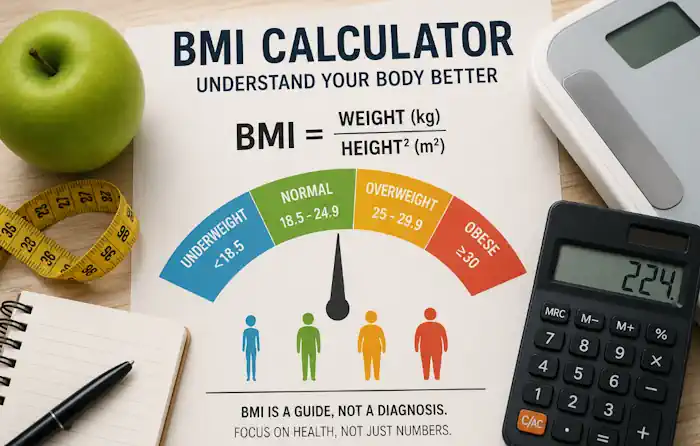
Most people treat the BMI calculator like a verdict machine. You enter your height and weight, and it spits out a category: underweight, normal, overweight, obese. Simple. Almost too simple.
But that’s exactly the problem.
BMI (Body Mass Index) — Body Mass Index — was never designed to judge how “healthy” you are as a person. It was created in the 19th century by a mathematician trying to describe average body proportions across populations, not individuals.
And yet here we are, using it as a shortcut for health.
What the BMI calculator actually does
At its core, the BMI formula is brutally simple: weight (kg) / height² (m²).
That’s it. No muscle mass. No fat distribution. No lifestyle. No genetics. Just two numbers.
This is why the BMI calculator can label a professional athlete as “overweight” and someone with low muscle and high body fat as “normal.” It’s not broken — it’s just limited.
Why people still use it
Even with its flaws, BMI sticks around for one reason: it’s fast and scalable.
Doctors, insurance companies, and researchers don’t need perfect accuracy for millions of people. They need a quick filter. BMI gives them that.
It’s less “this is your health status” and more “this is where you might fall on a broad statistical curve.”
The part nobody likes to admit
People often get frustrated when their BMI category doesn’t match how they feel in their body. But the real issue isn’t the calculator — it’s the expectation that one number should explain everything.
Health doesn’t fit into four boxes.
Two people with the same BMI can have completely different metabolic health, fitness levels, and risks. One might run marathons. The other might struggle with energy levels. Same number. Different reality.
So should you ignore BMI?
Not exactly.
Think of it like a blurry map. It’s not precise, but it can still show general direction. If your BMI is very high or very low, it might be a signal worth paying attention to — not a diagnosis, but a reason to look deeper.
The mistake is treating it as the final answer.
A better way to think about it
Instead of asking “What is my BMI?”, a more useful question is:
– How do I feel day to day?
– What’s my strength and stamina like?
– Are my habits moving me in a direction I actually want?
BMI is one data point. Not a conclusion.
And the sooner you stop treating it like a judgment, the more useful it becomes.