What Is Headless WordPress?
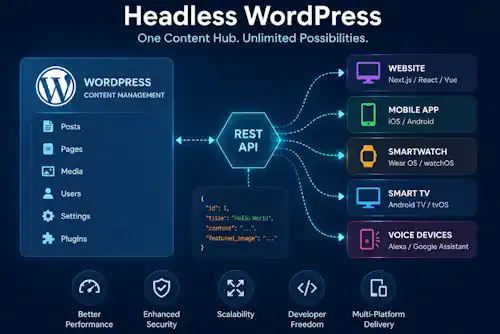
For years WordPress followed a familiar structure. The backend managed content, themes controlled design, and plugins added functionality. Everything existed inside one complete system.
Today a major shift is changing how websites are built. Developers increasingly separate content management from the visual presentation layer. This approach is known as Headless WordPress.
Headless WordPress removes the traditional front-end layer and uses WordPress only as a content management system. Instead of displaying pages through a WordPress theme, content is delivered through APIs and rendered by external technologies.
This approach is becoming one of the fastest-growing topics among developers, agencies, and businesses.
Why Traditional WordPress Is Changing
Modern users expect much more than static websites. People browse content on multiple devices including:
- Smartphones
- Tablets
- Smart TVs
- Smartwatches
- Applications
- Voice assistants
- Interactive displays
A traditional website was designed mainly for browsers. Modern digital experiences now require content to appear everywhere.
Businesses want to publish content once and distribute it across multiple platforms simultaneously.
This demand created the need for a more flexible architecture.
How Headless WordPress Works
The system separates two major parts.
Backend
WordPress continues managing:
- Articles
- Media files
- Users
- Categories
- Custom fields
- Settings
Frontend
A separate application displays content using technologies such as:
- React
- Next.js
- Vue
- Angular
- Mobile applications
The communication between these systems happens through APIs.
WordPress provides content data while external systems decide how users see it.
Why Businesses Are Interested
Companies increasingly seek faster, scalable, and more flexible digital experiences.
Headless WordPress offers several advantages.
Improved Performance
Traditional WordPress websites sometimes load unnecessary code from themes and plugins.
Modern frontend frameworks can generate extremely fast websites.
Fast loading improves:
- User experience
- Engagement
- Conversion rates
- Mobile performance
Greater Flexibility
Developers are no longer restricted by theme limitations.
They can create highly customized interfaces without modifying WordPress itself.
Better Scalability
Large websites with thousands of pages require systems capable of handling heavy traffic.
Headless structures can scale more efficiently than traditional setups.
Multi-Platform Publishing
One article can appear across:
- Websites
- Mobile apps
- Digital kiosks
- Voice assistants
- Smart devices
Content becomes reusable instead of platform-dependent.
The Role of APIs
APIs act as bridges between systems.
Instead of displaying pages directly, WordPress sends information in structured formats.
Typical information delivered through APIs includes:
- Post titles
- Article content
- Images
- Authors
- Comments
- Categories
- Metadata
Applications request data whenever necessary.
This creates highly dynamic digital experiences.
Popular Frontend Technologies
React
React remains one of the most widely used frontend libraries.
Developers appreciate:
- Reusable components
- Speed
- Large ecosystem
- Strong community support
Next.js
Next.js continues growing rapidly.
Benefits include:
- Server-side rendering
- Fast loading
- Static generation
- Improved performance
Vue
Vue attracts developers who want simplicity and flexibility.
Its learning curve is often considered easier compared to other frameworks.
Security Advantages
Security remains a major concern for website owners.
Traditional WordPress websites can become vulnerable because:
- Plugins may contain weaknesses
- Themes can introduce issues
- Login pages are publicly accessible
- Outdated software creates risks
Headless structures reduce some of these concerns.
Since users do not directly access the WordPress frontend, attackers have fewer visible entry points.
This does not eliminate security risks entirely, but it can reduce exposure.
Challenges of Headless WordPress
Although the technology offers advantages, it also introduces challenges.
Higher Complexity
Traditional WordPress websites can often be built quickly.
Headless projects usually require:
- Frontend development
- API management
- Hosting configuration
- Advanced debugging
Small businesses without technical resources may struggle.
Plugin Compatibility
Many plugins were designed for traditional themes.
Features sometimes require custom development to function properly in headless environments.
Learning Curve
Developers must understand multiple technologies.
Instead of learning only WordPress, they may need knowledge of:
- JavaScript
- API structures
- Frontend frameworks
- Hosting systems
Who Should Consider Headless WordPress?
Not every website requires this architecture.
Good candidates include:
- Large businesses
- Media companies
- News websites
- Mobile applications
- High-traffic platforms
- Custom web applications
Smaller blogs and local business websites may continue performing well using traditional WordPress systems.
The Future of WordPress Development
The evolution of the internet continues accelerating.
Users increasingly expect:
- Faster experiences
- Interactive interfaces
- Personalized content
- Cross-platform availability
- Real-time functionality
Headless WordPress represents one possible direction for meeting these expectations.
As frontend technologies become more advanced and development tools become easier to use, adoption will likely continue growing.
Many developers already believe the future of content management will focus less on websites and more on connected digital ecosystems.