USA vs Russia: What Would Really Happen in a War, and Who Would Win?
What would actually happen if the United States and Russia went to war, and could anyone win? Together the two countries own about 86% of the world’s nuclear weapons, and since 5 February 2026, when the New START treaty expired, no treaty limits how many they can deploy. In this video we look at the numbers, the scenarios experts study and what science says about the consequences.
Chapters
- 00:00 86% of the world’s nuclear weapons
- 00:27 The numbers: spending, armies and allies
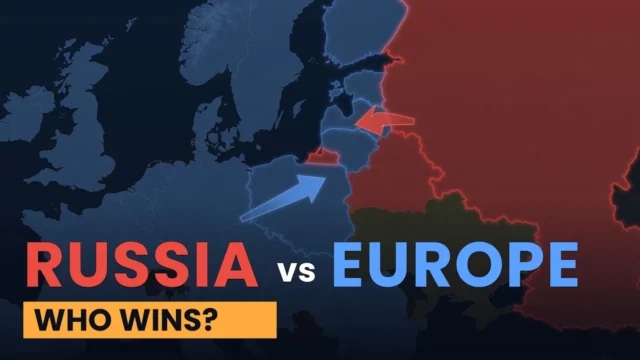
- 01:01 Where a war could start: the Baltic flank
- 01:35 The global shock, even without nuclear weapons
- 02:02 Nuclear arsenals and mutually assured destruction
- 02:29 Close calls: 1962 and 1983
- 02:58 Princeton’s “Plan A” simulation
- 03:27 Nuclear winter and global famine
- 03:59 So, who would win?
The numbers
| United States | Russia | |
|---|---|---|
| Military spending, 2025 (SIPRI) | about $954 billion (3.1% of GDP) | about $190 billion (7.5% of GDP) |
| Allies | 31 NATO allies | no comparable alliance |
| Nuclear warheads, total inventory (FAS 2026) | about 5,040 | about 5,420 |
| Deployed, ready to use (FAS 2026) | about 1,770 | about 1,800 |
Key points
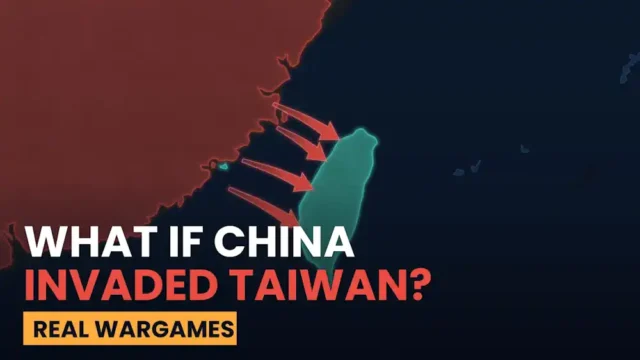
- Where it could start: in RAND wargames published in 2016, Russian forces reached the outskirts of Tallinn and Riga within about 60 hours. Since then NATO has moved more forces east, and Finland (2023) and Sweden (2024) have joined the alliance.
- A long conventional war: most analysts expect NATO’s air power and economic weight to give it the upper hand, which is exactly when the risk of nuclear escalation would be highest.
- Global shock: energy, wheat and fertilizer prices, financial markets, satellites and power grids would be hit far from any front line.
- Close calls: the Cuban Missile Crisis (1962) and the false alarm judged correctly by Soviet officer Stanislav Petrov (1983).
- Escalation: Princeton’s “Plan A” simulation estimates about 91.5 million people killed or injured within the first few hours.
- Nuclear winter: after a full US–Russia nuclear war, soot could cut global food production by about 90% within 3–4 years, and more than 5 billion people could die from hunger (Xia et al., Nature Food, 2022).
“A nuclear war cannot be won and must never be fought.”
Reagan and Gorbachev, 1985; reaffirmed by the leaders of the USA, Russia, China, the UK and France, 2022
Sources
- SIPRI: Trends in World Military Expenditure, 2025 (April 2026)
- Federation of American Scientists: Status of World Nuclear Forces 2026
- RAND Corporation: Reinforcing Deterrence on NATO’s Eastern Flank (2016)
- Princeton Program on Science and Global Security: “Plan A” (2019)
- Xia et al. (2022), Nature Food 3, 586–596
- Joint Statement of the Leaders of the Five Nuclear-Weapon States (3 January 2022)
- Bulletin of the Atomic Scientists: 2026 Doomsday Clock Statement
This is an educational analysis based on published research and does not take a political side. Subtitles are available in English and Bulgarian.