What If AI Took All the Jobs? A Real-Data Scenario
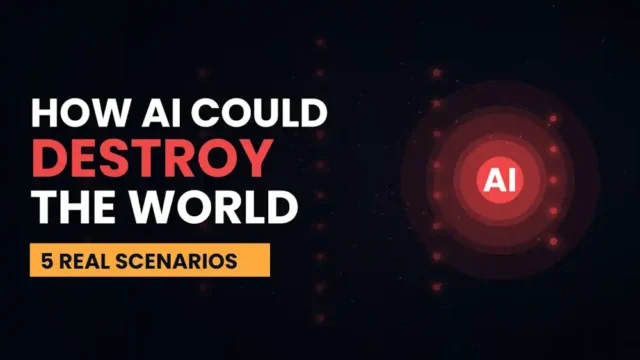
Imagine a Monday morning when the alarm rings and there is nowhere to go. Not just for you, but for almost everyone. This video is a thought experiment, not a forecast, but every number in it comes from real research. What would happen to the economy, to governments and to people if artificial intelligence took all the jobs?
Where we are today
In January 2024 the IMF estimated that almost 40% of jobs worldwide are exposed to AI, rising to about 60% in advanced economies. Roughly half of those jobs could benefit from AI, while the other half could face lower wages and less hiring. The World Economic Forum expects 92 million jobs to be displaced and 170 million created by 2030. Overall unemployment remains low, but Stanford researchers find that workers aged 22 to 25 in the most AI-exposed jobs now trail their peers in employment by around 19%. They are not being fired. They are simply not being hired.
The economic trap
Wages are the fuel of the economy. If machines do the work, who buys what they produce? Without income, demand collapses, and governments lose the taxes on labour that pay for pensions, hospitals and schools. An economy could produce more than ever and still choke.
History: the Luddites, Keynes and the horse
In 1811 the Luddites smashed weaving machines, yet work did not disappear. It changed. In 1930 Keynes predicted a 15-hour working week. But American farms went from 21.4 million horses in 1915 to just 3.1 million horses and mules in 1960, as tractors took over, and no new jobs appeared for them. The question is whether AI will be our steam engine or our tractor.
Universal basic income: what the trials found
- Finland (2017–2018): 2,000 unemployed people received €560 a month. Employment barely changed, but recipients reported better wellbeing and less stress.
- OpenResearch (USA): 1,000 people received $1,000 a month for three years. They spent it on food, rent and transport, and worked about 1.3 hours less per week. They did not stop working.
Three possible futures
- A golden age: AI makes almost everything cheap, working weeks get shorter, and gains are shared.
- Digital feudalism: a tiny elite owns the AI while most people live on minimal payments.
- Somewhere in between: slow, uneven change, new professions and a painful transition for millions.
Technology does not decide our future on its own. Laws, taxes and the choices we make today will. Which future do you think is coming? Tell us in the comments on YouTube.
Subscribe for more videos that explain the world with real data: youtube.com/@askiw5446
Sources: IMF SDN/2024/001; World Economic Forum, Future of Jobs Report 2025; Stanford Digital Economy Lab (2025, updated 2026); USDA via Historical Statistics of the United States; J. M. Keynes (1930); Kela, Finnish basic income experiment final report (2020); Vivalt et al., NBER WP 32719 (2024); Case & Deaton (2020).